Get a quoate
Crucial HVAC Design Parameters for Cleanroom Air Conditioning Systems
Published : 2026-05-17Before initiating a cleanroom HVAC design, HVAC system designers must possess a profound understanding of sterile product characteristics, process sequences, and equipment operations. Corresponding measures must be integrated into the HVAC design to optimize critical components such as airflow patterns, airflow visualization, and filtration efficiency in accordance with GMP compliance and sterile manufacturing requirements. This ensures that the aseptic production environment consistently satisfies product and process specifications while aligning precisely with the ISO 14644-1 classification standards.
I. Understanding Sterile Product Characteristics: The Foundation of Cleanroom HVAC Design
A comprehensive understanding of the unique properties of sterile products forms the baseline of any engineering project. The core direction of air conditioning system parameters is directly dictated by these product characteristics:

- Terminal Sterilization Capability: Whether the product can undergo final sterilization or requires absolute aseptic processing.
- Processing Thresholds: Strict operational tolerances, specifically the relative humidity (RH) control range and temperature boundaries.
- Occupational Exposure Limits (OEL): Safety thresholds for personnel regarding substance exposure.
- Product Type and Physicochemical Parameters: The physical form of the medicine (liquids, dry powders, solid mixtures) and its specific chemical liabilities (e.g., hygroscopicity).
II. Mapping Process and Production Flows: Environmental Grading and Protection Systems
To deliver a compliant design, HVAC engineers must analyze specific process and production information that directly impacts cleanroom zoning and localized environmental protection systems.
1.Product Flow and Pressure Dynamics
Designers must map the exact path of the product to mitigate contamination risks:
- The Point of Sterility: Identifying precisely where the product becomes “sterile.”
- Aseptic Area Entry: How the product enters the sterile manufacturing zone, ensuring compliance with strict cleanroom ventilation requirements to guarantee a contamination-free transfer.
- Environmental Exposure: Pinpointing where the product is exposed to the ambient environment before final sealing.
- Final Packaging and Sealing: Understanding how the product is transferred into its primary container and protected prior to final closure. This requires a robust differential pressure gradient design to prevent the infiltration of outdoor or lower-grade contaminants.
- Aseptic Area Exit: The mechanism by which the sealed product leaves the sterile perimeter.
- Zoning Note: Surrounding ring corridors must maintain a calibrated differential pressure gradient and sufficient air change rates (ACR). This must be coupled with a dedicated make-up air system (MAU) to introduce clean outdoor air, ensuring the zone satisfies the designated ISO 14644-1 classification.
2.Container and Packaging Component Flow
The introduction of packaging materials represents a major contamination vector:
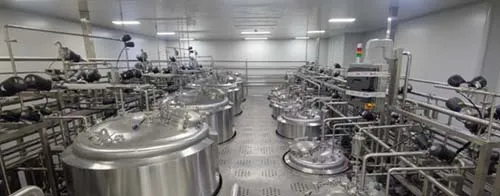
- Washing and Sterilization Protocols: How containers/closures are cleaned and through what type of sterilization process they pass.
- Aseptic Zone Entry and Cooling: How components enter the sterile zone. If air cooling is required post-sterilization, the HVAC system parameters must be dynamically adjusted to control localized temperature and humidity fluctuations.
- Equipment Loading: The method of placing sterile components onto filling or crimping machines.
- Localized Critical Zone Protection: How the critical zones hosting sterile components are isolated. Designers should optimize airflow patterns and utilize airflow visualization to confirm the absolute absence of stagnant air zones or turbulence.
System Application: The formulation and compounding areas require a dedicated air handling unit (AHU) to achieve precise relative humidity (RH) control and target air change rates. High-capacity HEPA filters must be deployed to guarantee rigorous filtration efficiency and meet GMP compliance benchmarks.
3.Personnel Intervention and Dynamics
Human operators are the primary source of particulates and microbial shedding in a cleanroom:
- Intervention Mapping: Identifying where and how frequently operators interact with exposed products or direct-contact primary containers.
- Material Handling: The mechanics of transporting products within the aseptic core. Material transit pathways must avoid dead zones, verified via airflow visualization.
- Occupancy Load Calculations: Determining the maximum number of personnel in both preparation and sterile zones (production, validation, sampling, and maintenance staff). This occupancy directly impacts the calculation of air change rates and make-up air system (MAU) cooling/heating loads.
- Operator Positioning: Mapping where operators stand during routine tasks. Positions must be engineered to avoid disrupting the downstream air of FFU (Fan Filter Units), preserving optimal laminar airflow patterns and localized filtration efficiency.
4.Process Equipment Integration
The interaction between mechanical equipment and environmental control is critical:
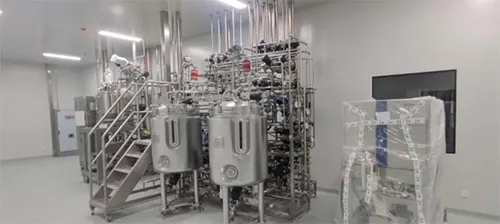
- Sterilization and Transfer Equipment: The type of equipment (e.g., depyrogenation tunnels, autoclaves) used to bridge non-clean and clean zones. Equipment heat rejection and pressure differentials must be balanced within the HVAC system parameters to stabilize zone temperature, humidity, and pressure.
- Component Stacking: Whether sterilized containers are accumulated or stacked post-sterilization, which can obstruct unidirectional airflow. Accumulation zones must be optimized using airflow visualization.
- Equipment Particle Generation: Identifying moving parts that generate micro-particles. This requires upgrading localized filtration efficiency using HEPA / ULPA filters to capture contaminants at the source.
- Routine Maintenance Access: Designing how equipment is serviced from within or outside the cleanroom. Maintenance procedures must preserve cleanroom ventilation requirements to block external ingress.
- Equipment Layout: Equipment zones must feature a strategic layout of FFU (Fan Filter Units) and air handling units (AHU) to ensure mandatory air change rates are consistently met. Cleanliness must be locked in via high-efficiency HEPA / ULPA filters to conform to ISO 14644-1 classification and sterile manufacturing mandates.
5.Auxiliary Operations and Environmental Safeguards
- Miscellaneous Material Entry: Protocols for bringing in secondary items like environmental monitoring equipment, tools, logbooks, and disinfectants via HEPA-filtered, single-pass air locks or pass boxes.
- Aseptic Storage: Defining storage zones for sterile machine parts or spare process filters within the clean perimeter.
- Sanitization and Washdown Cycles: Understanding the facility’s chemical cleaning procedures. The HVAC system must utilize high air change rates and rapid exhaust routines to purge chemical vapors and moisture post-sanitization.
- Facility Operational Hours: Setting HVAC setback modes for non-operational hours versus full-load performance during manufacturing campaigns to balance energy efficiency with continuous GMP compliance.
- Pressure Barrier Interlocks: Deploying interlocking doors and pressure alarms to protect the differential pressure gradient from momentary disruptions during personnel transitions.
- High-Risk and Containment Variables: Addressing specialized processes that involve potent compounds (hazardous dust, toxic materials), biosafety considerations, or explosion-proof requirements by integrating specialized containment filtration and negative-pressure airflow patterns.
Once the product properties, facility layout, process equipment details, and potential contamination risks are thoroughly defined, the environmental parameters become actionable.
With the critical “GMP Critical Parameters” and acceptance criteria locked in, the formal cleanroom HVAC design can proceed. By integrating ISO 14644-1 classification logic, engineers can optimize airflow patterns, airflow visualization, differential pressure gradients, and filtration efficiency. Selecting the precise configuration of FFU (Fan Filter Units), HEPA / ULPA filters, and air handling units (AHU)—while setting rigorous air change rates, relative humidity (RH) control, and robust make-up air systems (MAU)—guarantees an engineering solution that stands up to international regulatory scrutiny and secures long-term sterile manufacturing success.