Get a quoate
What Are the 4 Mandatory Tests for Clean Room Final Acceptance?
Published : 2026-05-06So, your clean room construction is complete—but is it actually compliant? As a clean room engineer with over 15 years of inspection experience, I often tell my clients: a clean-looking room with running equipment is not enough. To officially hand over a project, you must strictly follow the GB 50687-2011 code (or equivalent ISO 14644 standards).
Based on my years of on-site troubleshooting, here are the four mandatory performance indicators that determine whether a facility is ready for operation.
1.Airborne Particulate Count: The Hard Standard for Cleanliness
Airborne particle concentration is the core metric of any clean room. While we use laser particle counters for measurement, several operational details often lead to failed tests.
- Stabilization Time: The HVAC system must run for at least 30 minutes before testing. I’ve seen contractors try to test after 15 minutes to save time, only to find the readings spiked because the dust on filter surfaces hadn’t stabilized.
- Sampling Points: You cannot pick spots at random. The number of points depends on the floor area (e.g., a 100㎡ room requires at least 6 points). Each point must be sampled for at least 1 minute.
- The “Over-Engineering” Trap: A common mistake is trying to exceed the design grade (e.g., building a Class B room for a Class C design). This leads to oversized filters and astronomical energy costs. Meeting the design spec is the goal—efficiency is better than excess.
2.Microbiological Testing: The “Exclusive Audit” for Food Clean Rooms
This is the biggest differentiator for food-grade facilities. Since it directly impacts food safety, the margin for error is zero.
- Active Air Sampling (Bio-aerosol): We use impactor samplers (like the Andersen sampler) to measure CFU/m³. The sampler must be placed at the height of the actual food processing surface to ensure representative data.
- Settle Plates (Passive Monitoring): This is the most common field method. We expose 90mm agar plates for 4 hours. Pro-tip: Keep plates at least 0.5m away from walls and avoid placing them directly under supply air diffusers, as high airflow can skew the results.
- Critical Sequence: Microbiological tests must be performed after the particle count has passed. Testing personnel must strictly follow aseptic protocols—if you don’t use ice packs during sample transport in summer, the heat might kill the bacteria, resulting in a false “zero” reading.
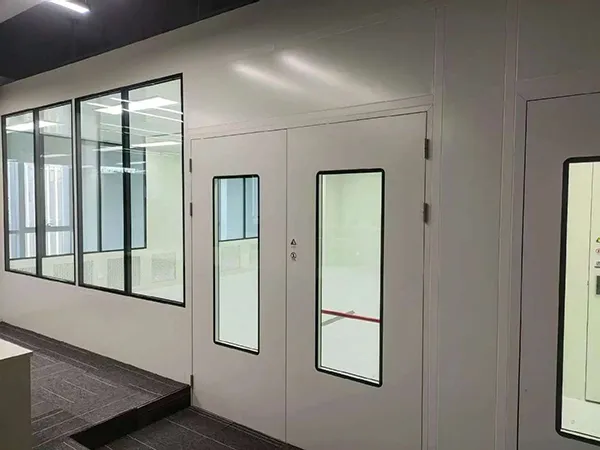
3.Differential Pressure (DP): The First Line of Defense Against Cross-Contamination
Differential pressure is what prevents contaminated air from infiltrating clean zones.
- The 5Pa Rule: The code requires a minimum positive pressure of ≥5Pa between a clean room and a non-clean zone, as well as between different cleanliness grades.
- Common Failures & Fixes: If you find insufficient pressure, check these four areas:
- Door Seals: Gaps are too large (install automatic closers or airtight doors).
- Air Supply: Insufficient volume (adjust fan speed or dampers).
- Return Air: Volume is too high (throttle the return air valves).
- Wall Penetrations: Unsealed pipe sleeves—this is the most overlooked leak point in my experience.
4.Temperature and Humidity: Impacting Product Quality and Stability
While these aren’t “cleanliness” metrics per se, they are vital for food shelf-life and process stability.
- Process-Specific Specs: While standard zones aim for 18–26°C and 45–65% RH, extreme zones (like flash-freezing at -18°C or high-temp steaming at 80°C+) must be tested against their specific process standards.
- Seasonal Validation: This is a step many skip. To be truly compliant, commissioning should be tested during the hottest summer months and the coldest winter months to verify that the HVAC system can handle extreme outdoor loads. I once saw a bakery pass in summer but fail in winter, causing products to dehydrate and crack. Don’t cut corners on seasonal testing.
Pro-Tips from the Field: Avoiding Common Commissioning Pitfalls
- Prioritize DP Over HVAC Power: If your cleanliness is fine but pressure is low, fix the seals before cranking up the fans. It’s cheaper and more sustainable.
- The “Night Shift” Test: Many rooms pass during the day but fail at night when the system switches to “standby mode.” Always verify humidity levels during off-hours to prevent condensation issues.
- Microbial Overruns: If microbes exceed limits, it’s rarely just one issue. Check filter integrity, structural seals, personnel gowning habits, and even the sanitization of production equipment. It’s a holistic battle.